Free
For a single-branch lab getting off paper.
₹0/month
No card, no time limit
- 1 branch
- 3 staff logins
- 300 reports a month
- Email delivery only
Lab information system for Indian diagnostic labs
Register patients, barcode samples, validate results and release pathologist-signed reports that patients verify by QR code. Free forever for one branch, and hosted in India.
14 days of the Growth plan for every new lab, no card needed.
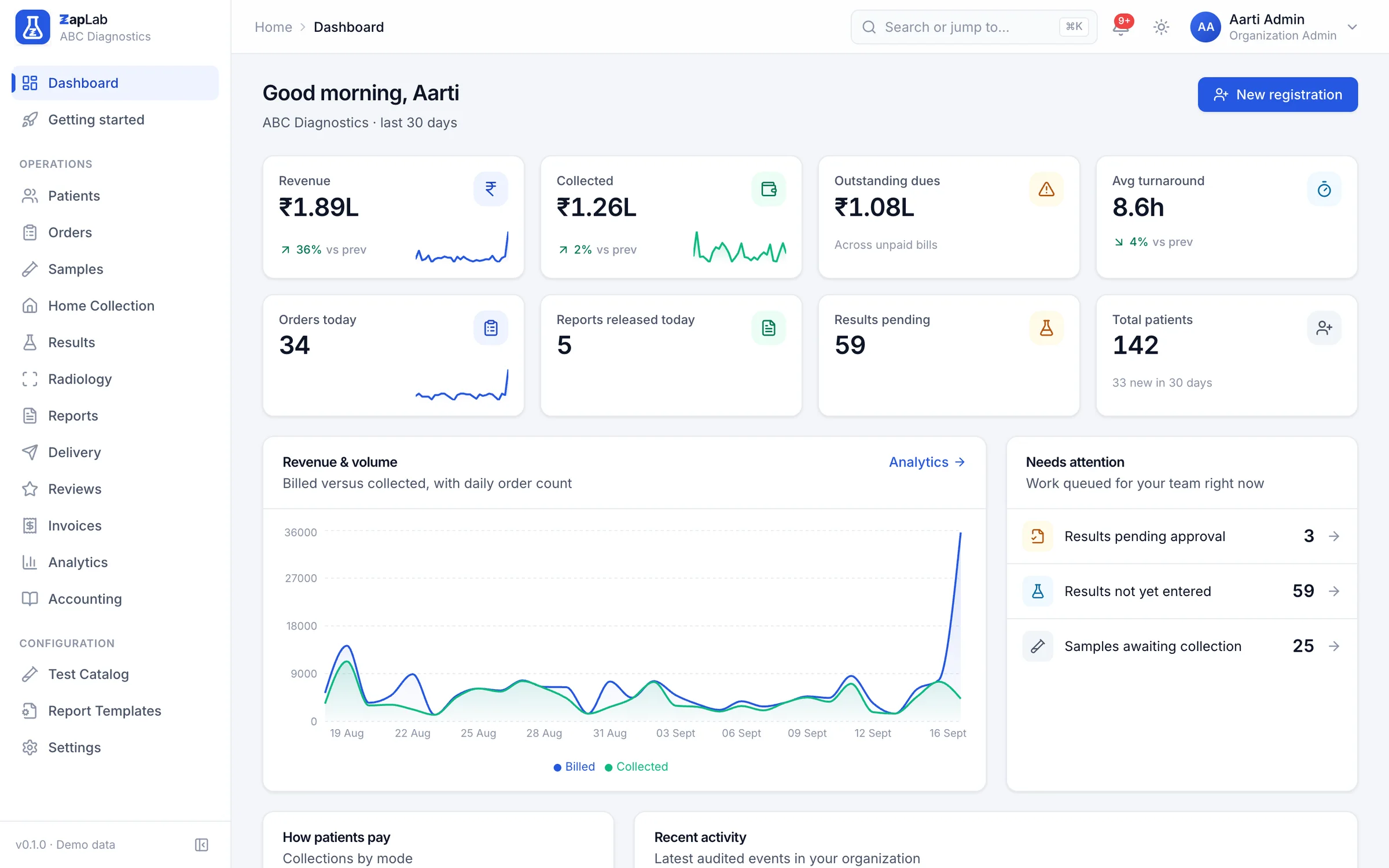
Counted from the format library that ships with the platform, not from a brochure.
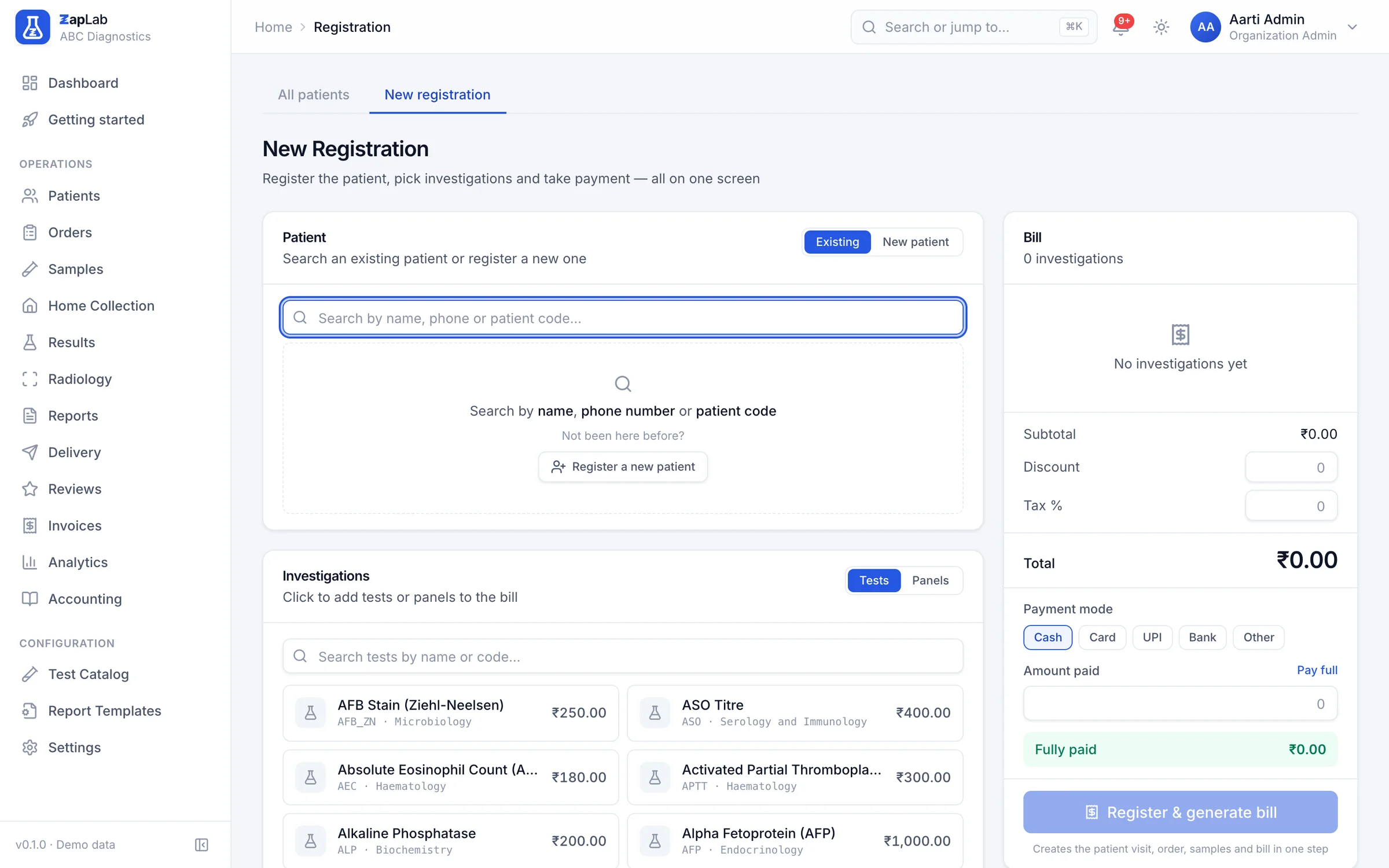
Every step a lab already takes, in order, on one screen each. Nothing to re-key, nothing to chase. The screenshots are the running system with demo data.
Find or add the patient, pick tests and panels from your catalogue, note the referring doctor, and print the invoice. Order, patient and sample numbers are assigned automatically.
Numbers come from an atomic counter, so two counters never issue the same one.
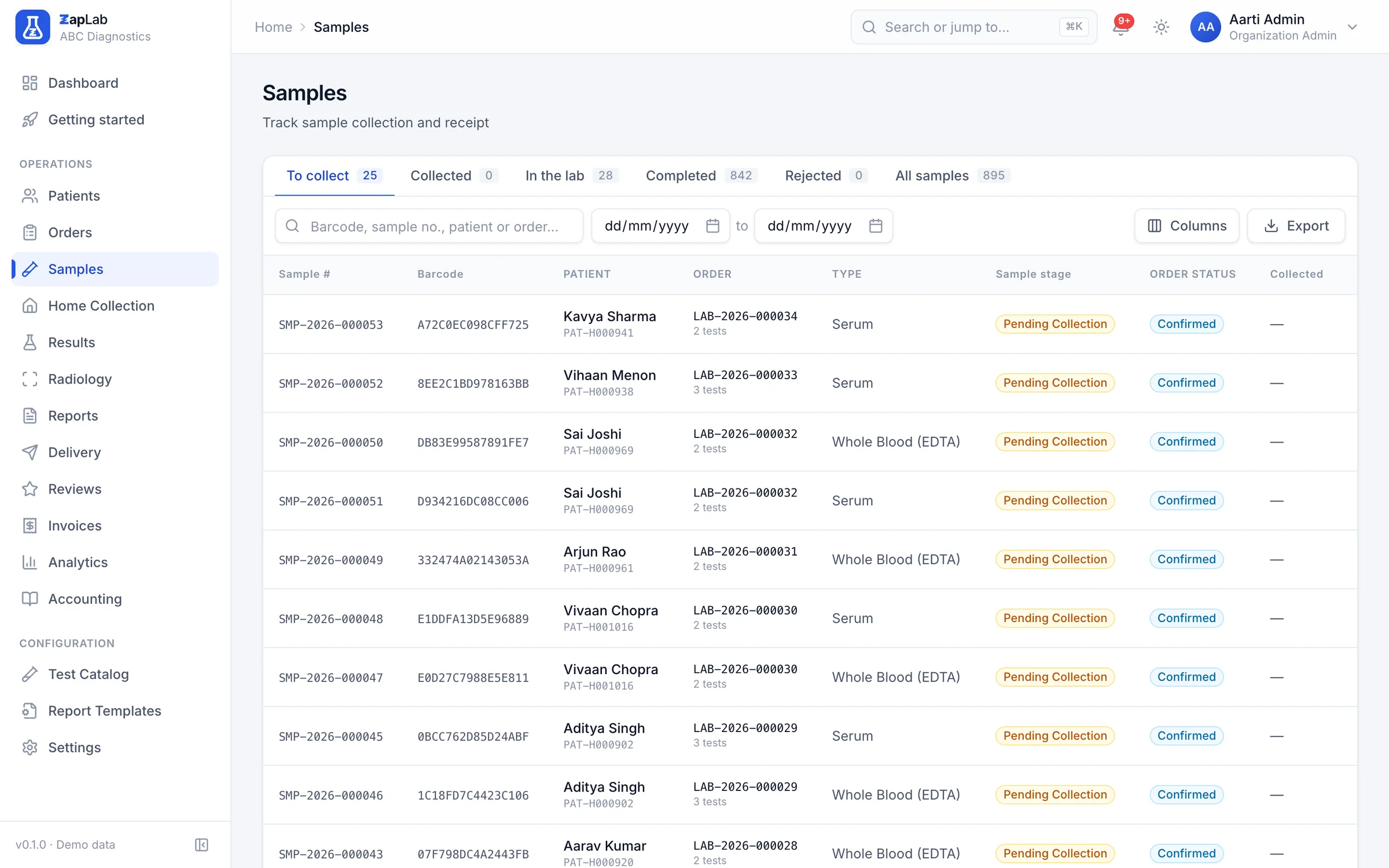
Print barcode labels at the counter or on a home-collection visit. Mark samples collected, received or rejected, with the reason on record.
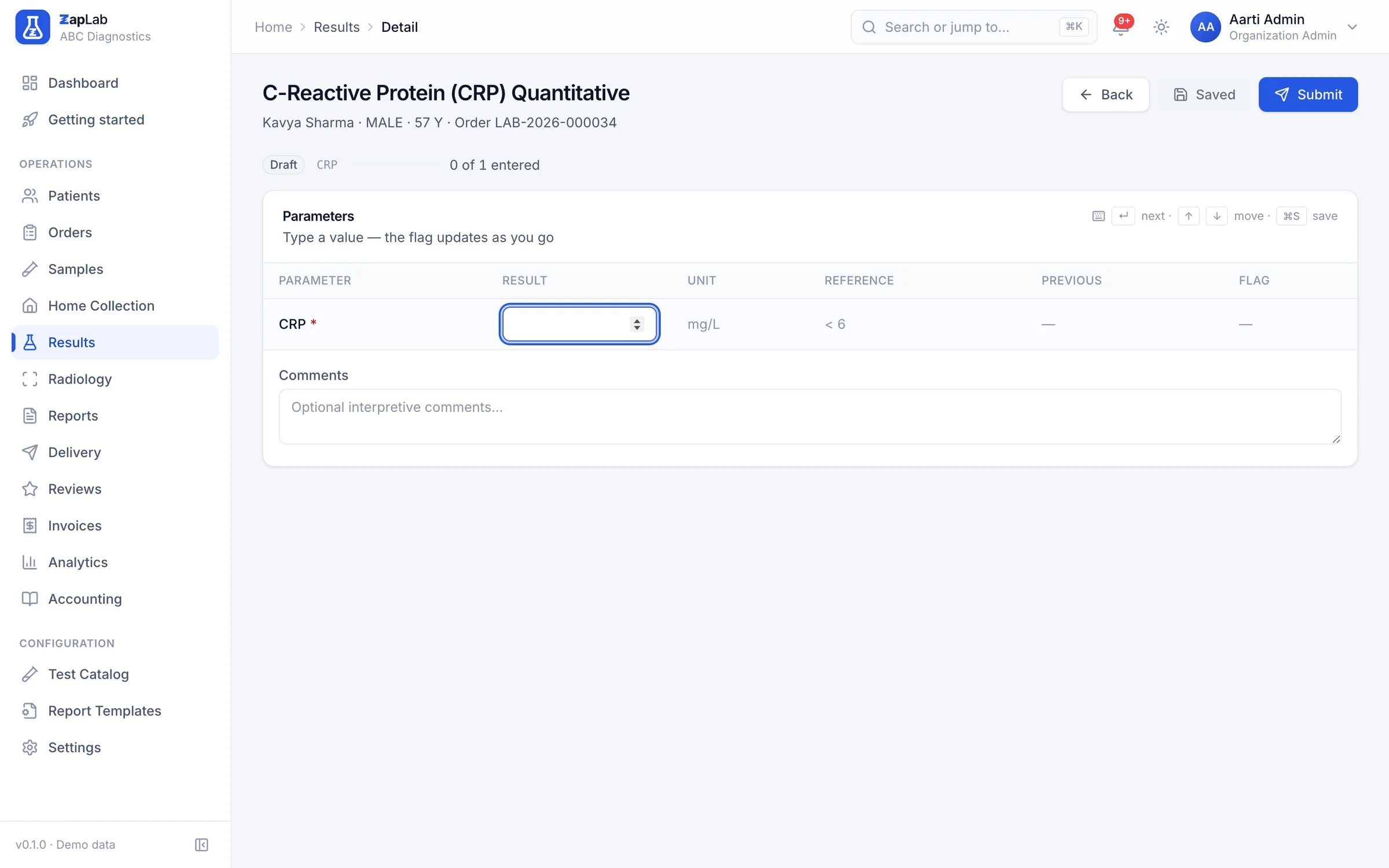
Type results in, or import them from an analyser. Reference ranges match the patient’s sex and age, and parameters with a formula fill themselves in.
Range selection by sex and age lives in apps/api/src/results/range-selection.ts.
Flags, critical values and the previous result are shown to the pathologist. One click to sign; every change stays in the audit trail.
Flags and critical limits are decided here, not typed in by hand.
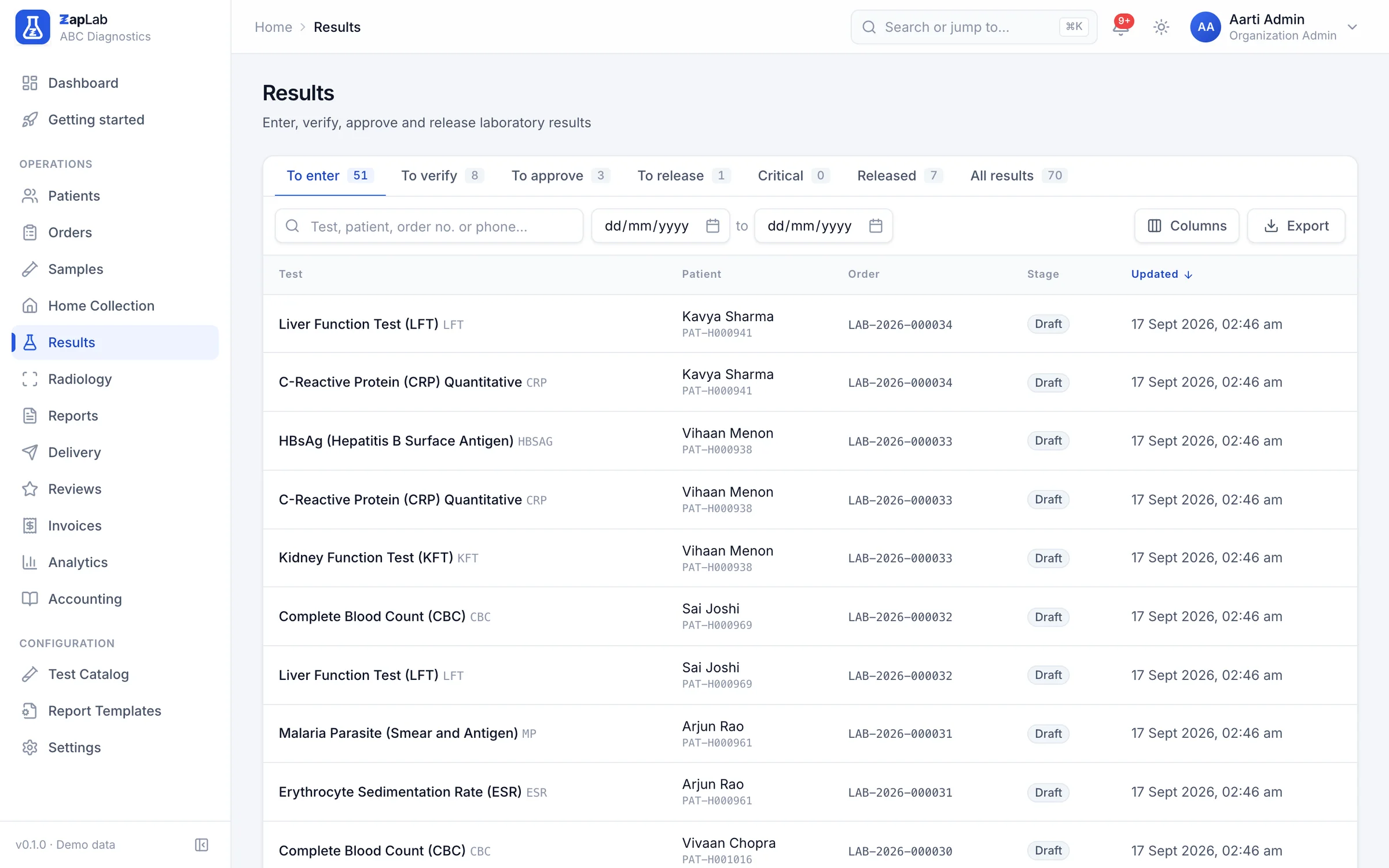
Reports go out on email, WhatsApp or SMS the moment they are released. Each carries a QR code that opens a verification page.
Delivery senders are in apps/api/src/delivery/providers.ts.
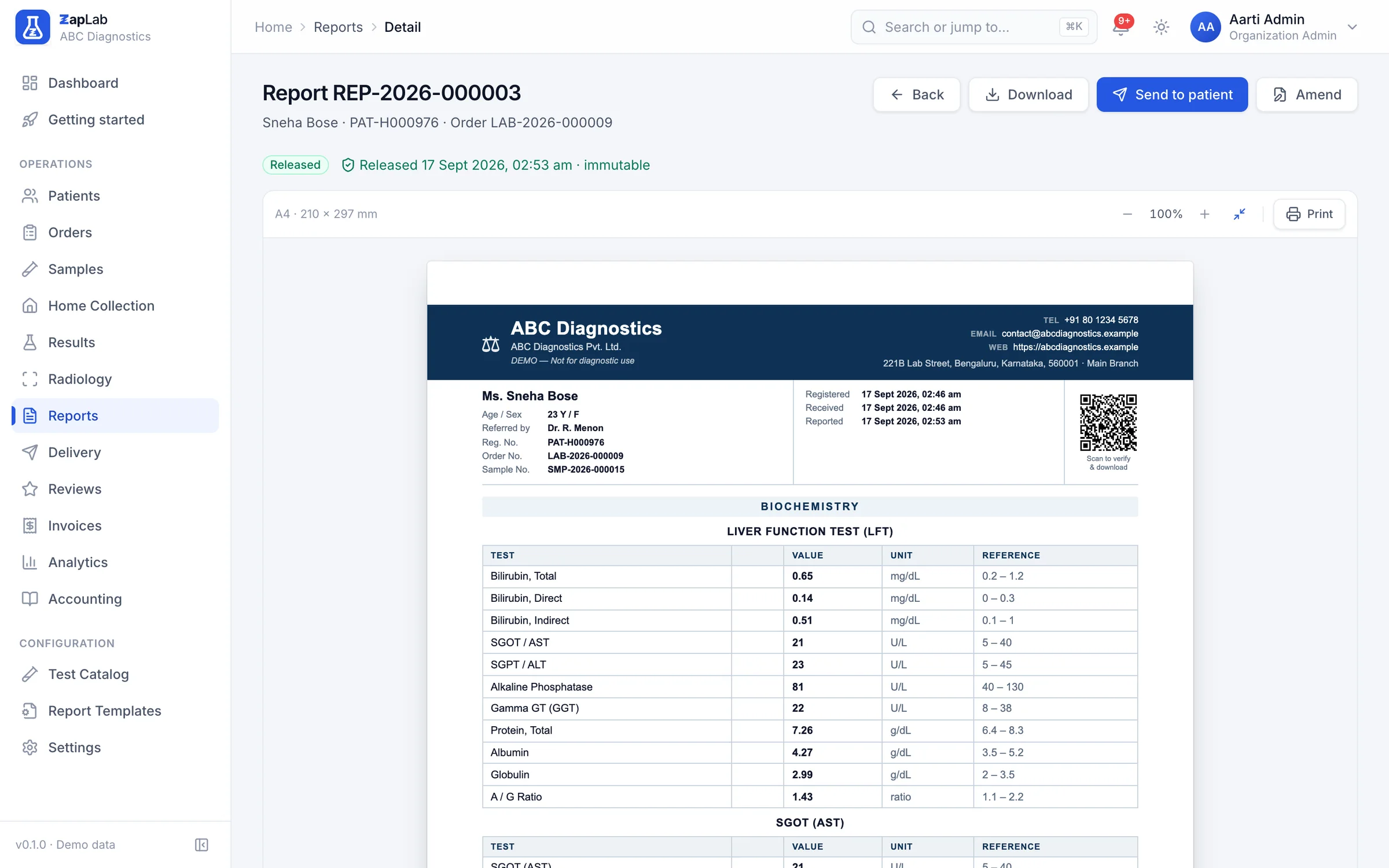
Install the departments you need into your own catalogue in one click, then edit every parameter, unit, decimal place and reference range. 157 formats across 8 departments, and 9 panels with 7 checkup packages on top.
25 tests · 63 parameters
Blood counts and cell morphology, coagulation times, blood grouping, malaria smears and haemoglobin studies.
48 tests · 95 parameters
Liver, kidney, lipid and glucose profiles, electrolytes, iron studies, cardiac enzymes, and the single analytes behind them.
8 tests · 54 parameters
Urine, stool, semen and body-fluid examinations, each reported as a physical and chemical section plus microscopy.
32 tests · 51 parameters
Viral markers and rapid infection screens for dengue, typhoid and the rest, with inflammatory and autoimmune antibody tests.
27 tests · 34 parameters
Thyroid, fertility, steroid and vitamin assays, together with the tumour markers labs run on the same analyser.
9 tests · 54 parameters
Culture and sensitivity for urine, blood, pus, sputum, throat and stool samples, with Gram, AFB and KOH stains.
4 tests · 6 parameters
Real-time PCR formats: COVID-19, tuberculosis, and hepatitis B and C viral loads.
4 tests · 19 parameters
Biopsy and cytology reporting: histopathology, frozen section, fine needle aspiration and cervical smears.
The same endpoint the app calls to install the shipped library into your catalogue in one click.
The report is the thing your patients and referring doctors actually see, so look at it before anything else.
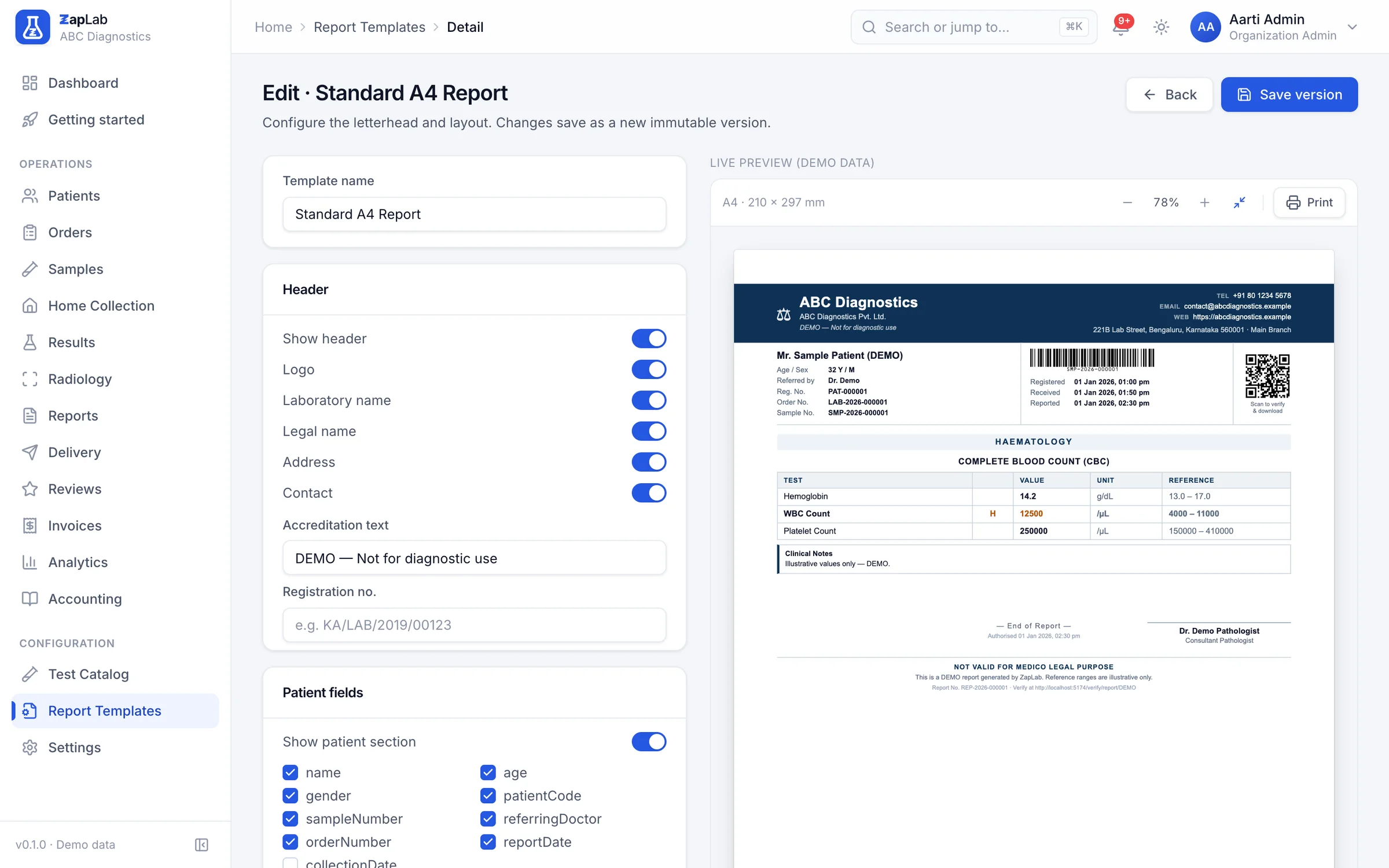
These are the switches your lab flips once in report settings. Turn one off and the sheet beside it changes, exactly as the printed report does.
Demo datafictional patient, sample values
ABC Diagnostics
18 Jyoti Nivas Road, Koramangala, Bengaluru 560095
Your accreditation line prints here
Haematology · Whole Blood (EDTA) · CBC
| Parameter | Result | Unit | Reference | Method |
|---|---|---|---|---|
| Haemoglobin | 11.4L | g/dL | 12 – 15Female | Automated Cell Counter |
| RBC Count | 4.10 | million/µL | 3.8 – 4.8Female | Automated Cell Counter |
| PCV / Haematocrit | 34.5L | % | 36 – 46Female | Automated Cell Counter |
| MCVcalculated | 84.1 | fL | 83 – 101 | Automated Cell Counter |
| MCHcalculated | 27.8 | pg | 27 – 32 | Automated Cell Counter |
| MCHCcalculated | 33.0 | g/dL | 31.5 – 34.5 | Automated Cell Counter |
| RDW-CV | 13.2 | % | 11.6 – 14 | Automated Cell Counter |
| Total Leucocyte Count (TLC) | 7400 | /µL | 4000 – 11000 | Automated Cell Counter |
| Neutrophils | 58 | % | 40 – 80 | Automated Cell Counter |
| Lymphocytes | 32 | % | 20 – 40 | Automated Cell Counter |
| Eosinophils | 4 | % | 1 – 6 | Automated Cell Counter |
| Monocytes | 5 | % | 2 – 10 | Automated Cell Counter |
| Basophils | 1 | % | 0 – 2 | Automated Cell Counter |
| Absolute Neutrophil Countcalculated | 4292 | /µL | 2000 – 7000 | Automated Cell Counter |
| Absolute Lymphocyte Countcalculated | 2368 | /µL | 1000 – 3000 | Automated Cell Counter |
| Platelet Count | 246000 | /µL | 150000 – 410000 | Automated Cell Counter |
| MPV | 9.8 | fL | 6.5 – 12 | Automated Cell Counter |
| RBC Morphology | Normocytic, normochromic | Automated Cell Counter |
Parameters marked calculated are computed by the system from the measured values on this sheet, not typed in.
Critical limits on the flagged parameters: Haemoglobin < 7 or > 20 g/dL. No value in this report has reached one.
Interpretation
Two values fall outside the reference range for this patient’s sex and are flagged. The red cell indices are calculated from the measured count. Correlate clinically.
Dr. Meera Nair, MD (Pathology)
Electronically signed 12 Sep 2026, 10:05
Dr. Anil Kumar, MD (Pathology)
Second signatory
Scan to verify
this report
Page 1 of 1 · End of report
Most labs we speak to type reports in a word processor or run installed software on one computer. Both work, up to a point.
| What you need | A word processor or spreadsheet | Installed offline software | This platform |
|---|---|---|---|
| Report formats ready to use | You build each format once as a document and copy the file for the next patient. | Usually ships a test list; how freely you can edit it depends on the vendor. | 157 formats ship with the platform, and every one of them is editable in your catalogue. |
| QR verification of a report | Nothing to verify against, so a report can be edited after it leaves the lab. | Offered by some, often as a paid add-on. | On every released report, with an optional date-of-birth check before details show. |
| WhatsApp or SMS delivery | You attach the file and send it yourself, one patient at a time. | Needs a separate messaging tool, and the log lives in that tool. | Built in, with a delivery log. WhatsApp needs your own WhatsApp Business sender. |
| Works from any device | Only on the computer that holds the file. | Only on the machines it is installed on, usually inside the lab. | Any browser, on a phone at a collection centre or a desktop in the lab. |
| Data kept off one machine | Whatever somebody remembers to copy to a pen drive. | Your own backup routine on that PC, and your own problem when it fails. | Managed cloud hosting in India, so nothing important lives on a single lab PC. |
Each module is part of the same system, so a patient registered at the counter is the same patient the pathologist signs for and the same one who gets the WhatsApp.
Start on Free, move up when you add a branch or want WhatsApp delivery. Prices are monthly, before GST.
For a single-branch lab getting off paper.
₹0/month
No card, no time limit
For a small lab that delivers reports on WhatsApp.
₹999/month
+18% GST, billed monthly, cancel any time
Every new lab starts with 14 days of Growth, no card
For multi-branch labs with analysers and radiology.
₹2,999/month
+18% GST, billed monthly, cancel any time
Every new lab starts with 14 days of Growth, no card
For lab chains and reference labs without limits.
₹9,999/month
+18% GST, billed monthly, cancel any time
Every new lab starts with 14 days of Growth, no card
Your lab this month
One released report per order. Reprints and amendments do not count again.
Collection centres count as branches.
Logins for your team. Referring-doctor logins are free.
Smallest plan that fits
Starter
Starter is the smallest plan that covers 1,200 reports a month, 1 branch and 4 staff logins.
Yes. Free covers one branch, three staff logins and 300 reports a month, with email delivery and QR-verifiable PDF reports. There is no card and no time limit. Reports on the Free plan carry a small "Powered by" line at the bottom.
New labs get the Growth plan for 14 days without entering a card. When the trial ends you move to the Free plan automatically. Nothing is deleted, and you can upgrade whenever you are ready.
No. A library of ready-made report formats ships with the platform: parameters, units, decimal places, calculated values and reference ranges for the tests Indian labs run every day, across haematology, biochemistry, clinical pathology, serology, endocrinology, microbiology, molecular biology and histopathology. Install the departments you need in one click, then add or edit tests freely.
In India, on managed cloud infrastructure. Every request is encrypted in transit, each lab’s data is isolated from every other lab’s, and you can export your data as CSV from any list at any time.
Growth and Enterprise include analyser result import. Map each analyser’s test codes to your catalogue once; results then arrive as CSV rows or through the API and land against the barcoded sample for the pathologist to verify. HL7 and ASTM are not parsed by the hosted service today; a small local bridge for them next to the analyser is planned.
Report templates are editable: letterhead, sections, fonts, signatures and footers, with a live A4 preview while you edit. Reports are generated as PDFs with a QR code that opens a verification page showing the report is genuine.
By email on every plan, and by WhatsApp or SMS on paid plans, with a monthly message allowance per plan. The bill carries a QR code that opens a tracking page showing which tests are done, and every report carries a QR code that opens a verification page. The lab can require a patient code or date of birth before any name is shown.
Yes, and most labs do it in an afternoon. There is no file import of old reports: you install the format library, add any tests of your own, upload your letterhead and signatures, and start registering new patients. Old reports stay where they are; new ones come out of the system.
Create your organisation, add your tests, print the first barcode. If you would rather see it first, ask for a walkthrough.